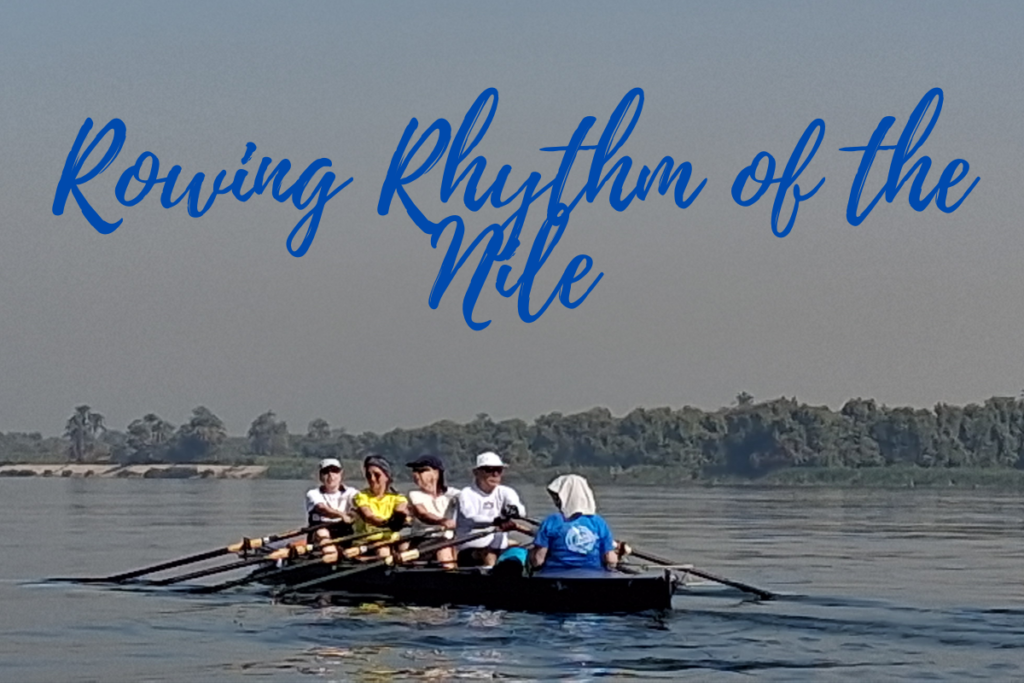
Rowing Rhythm of the Nile
Kom Ombo Temple is crowded. Clusters of languages gather around their guides, moving as a clump to the next feature. Our group waits for a group to move on before squeezing together in front of hieroglyphs that present an ancient calendar. Our guide explains that there used to be three seasons on the Nile: the floods, planting and the harvest. This annual rhythm is illustrated in changes in the manes of three standing lions, looking to the right. Yesterday a different guide at the massive High Dam at Aswan told us how the building of these structures disrupted that centuries old rhythm.
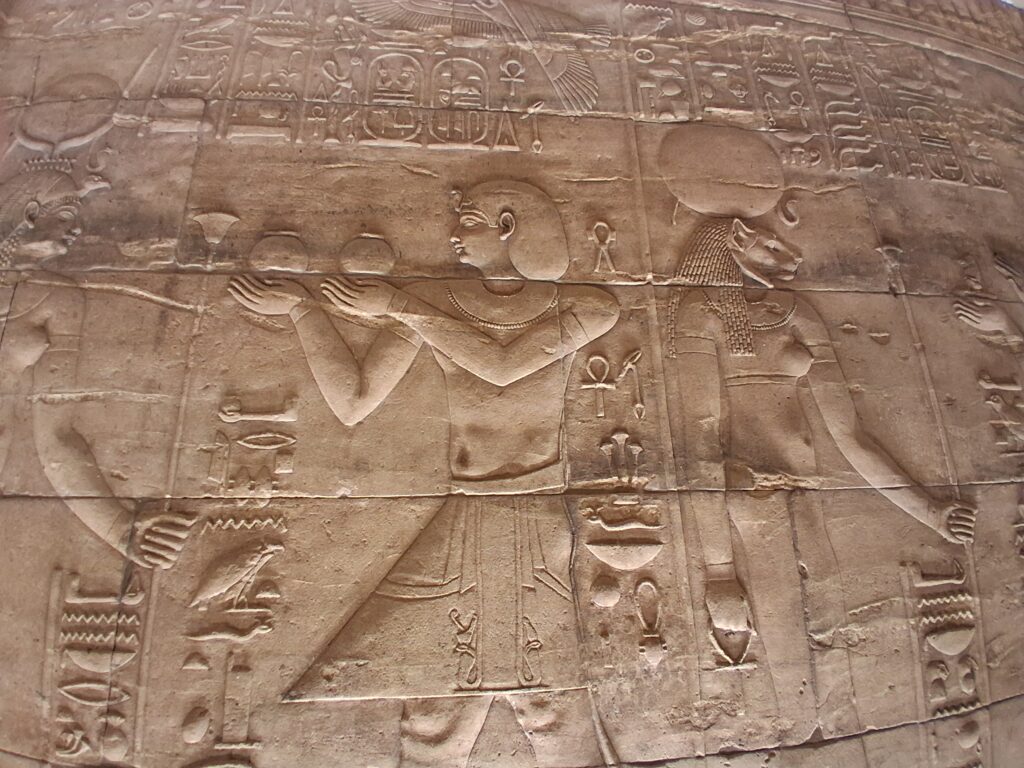
Also at Kom Ombo Temple our guide shows us an alcove where the high priest sat. We all immediately agree that Andrea Ranner is our high priest, and she climbs into the seat for photographs. Andrea is the reason we are here, rowing on the Nile River in Egypt. It has taken her years, coordinating with Emma Benany of Cairow to develop the itinerary and finalize arrangements. Then she gathered the participants, handled payment of fees and managed the daily decisions with the local team. All as a volunteer. Andrea sat on World Rowing commissions linked to tour rowing and works deeply with the Austrian Rowing Federation. We gladly anoint her high priest for her years of experience and for her calm and careful collaboration that finds us here, on the banks of the Nile.
We leave the temple and take a quick buzz through a museum to inspect mummified crocodiles. A short walk along the waterfront and we escape the crowds to board our dahabeya. This is our home for our four days and three nights of rowing the Nile River between Aswan and Luxor. The crew casts off and our floating hotel heads downstream, away from the crush of multi-story, diesel-belching Nile cruise ships. A dahabeya is a traditional, flat-bottomed sailing vessel, with two masts, one at the stern and one at the bow, each cocked at a jaunty angle. The sails are never unfurled but our stately progress down the river is quiet. We are towed. A long tow line separates us from the engine of our tug. We hear just the creaks of the massive tiller, pushed and pulled by a crew member through a complicated system of ropes and pulleys. Now we can find our own rhythm on the Nile.
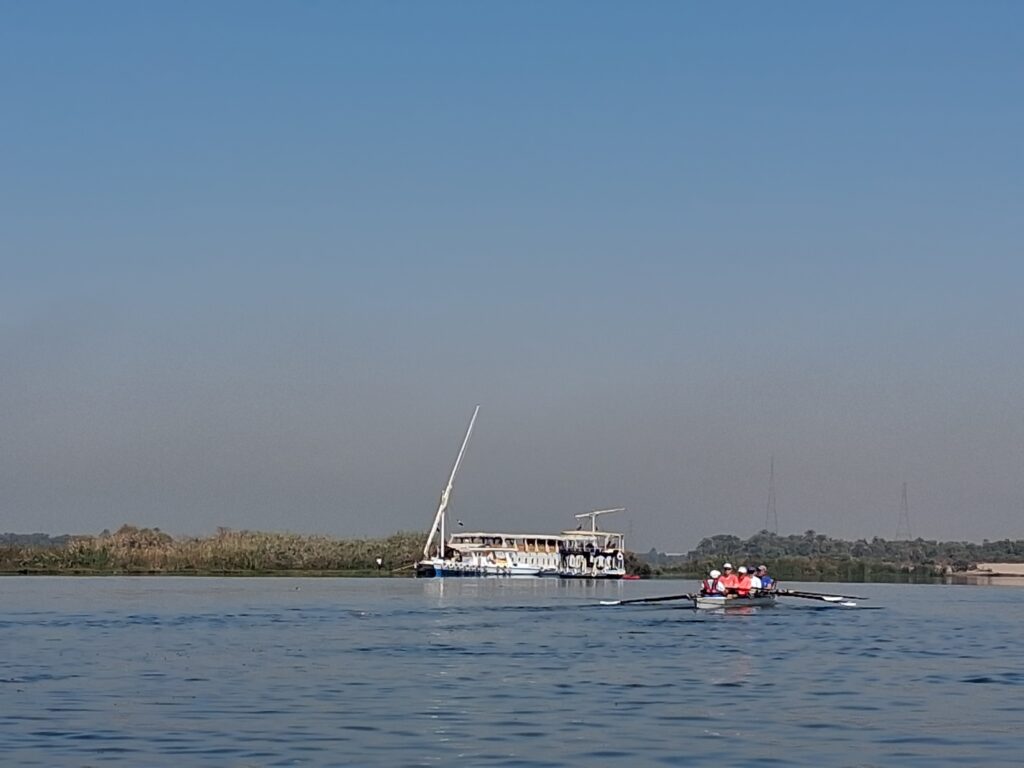
Our dahabeya, Razis, is magnificent, all gleaming wood and white paint, scattered carpets on the wooden floors. The lower deck has ten spacious guest cabins – exactly right for our group of 20 rowers – plus staff cabins and the kitchen. The aft and fore decks of the upper level open to the sky. We lounge on cushions, cozy up on couches or sprawl on sun beds. A long table fills the centre upper deck – we take our meals here, served buffet style. Tea and coffee are always on offer and from a small bar we can be served, always with a smile, fresh fruit juices and other drinks. Beer has been brought on board specially for us. I quickly learn the Austrian German word “schmutzbier” – the beer you drink before you take your shower and clean up.
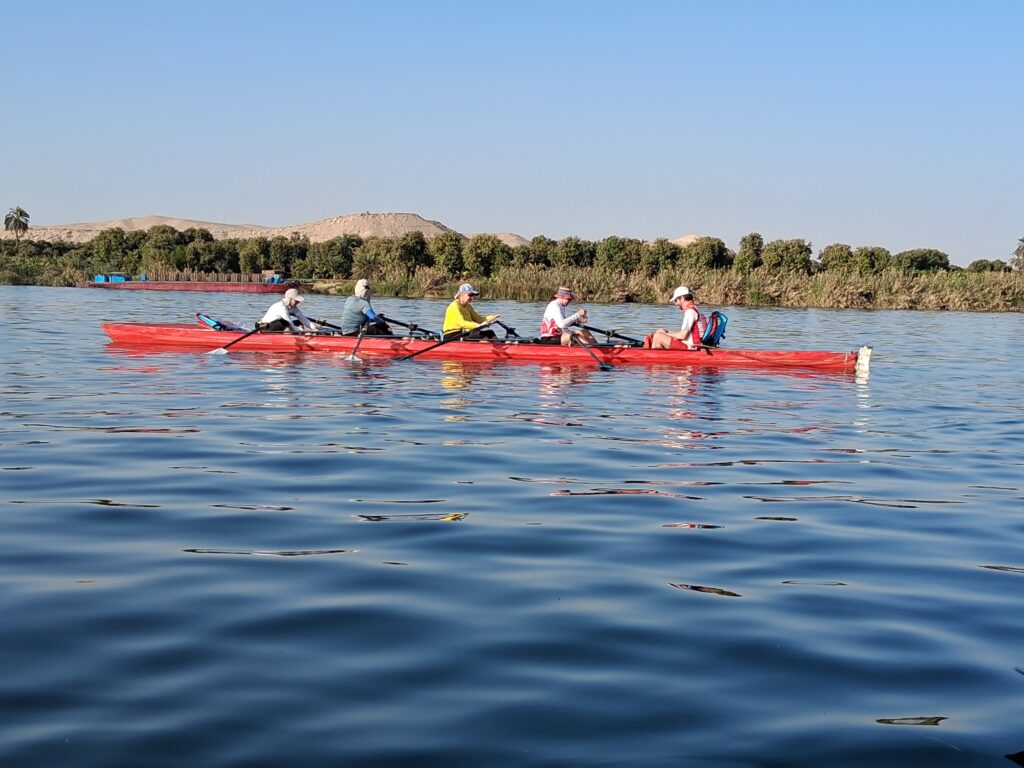
Our group is thrilled with our good fortune. Fourteen rowers are from Austria, two from the USA and one each from Netherlands, Sweden, Switzerland and me from Canada. Two people had previously been to Red Sea resorts decades ago, but for all of us, it is our first real immersion in Egypt. For some it is their first time in Africa. Egypt feels exotic and exciting, rowing the Nile feels adventurous. None of us were 100% sure exactly what it would be like. We are all delighted, our expectations far exceeded. The dahabeya is luxurious, the food plentiful and excellent. Most importantly, all elements of the rowing are wonderful. The four coxed quads work well and virtually no on-water repairs are needed – not something that I can say for every tour. Best of all are our superb rowing guides, Ali and Ahmed. One day Ali leads the group by kayak and twice Ahmed rows when one guest is sidelined with an injury. Bassam and the crew of our support boat Nubian Kingdom are flawless, as well as the crew of the dahabeya. As rowers our inclination was to help with the boats. We quickly learn to step back. The crew has their systems and they are very competent.
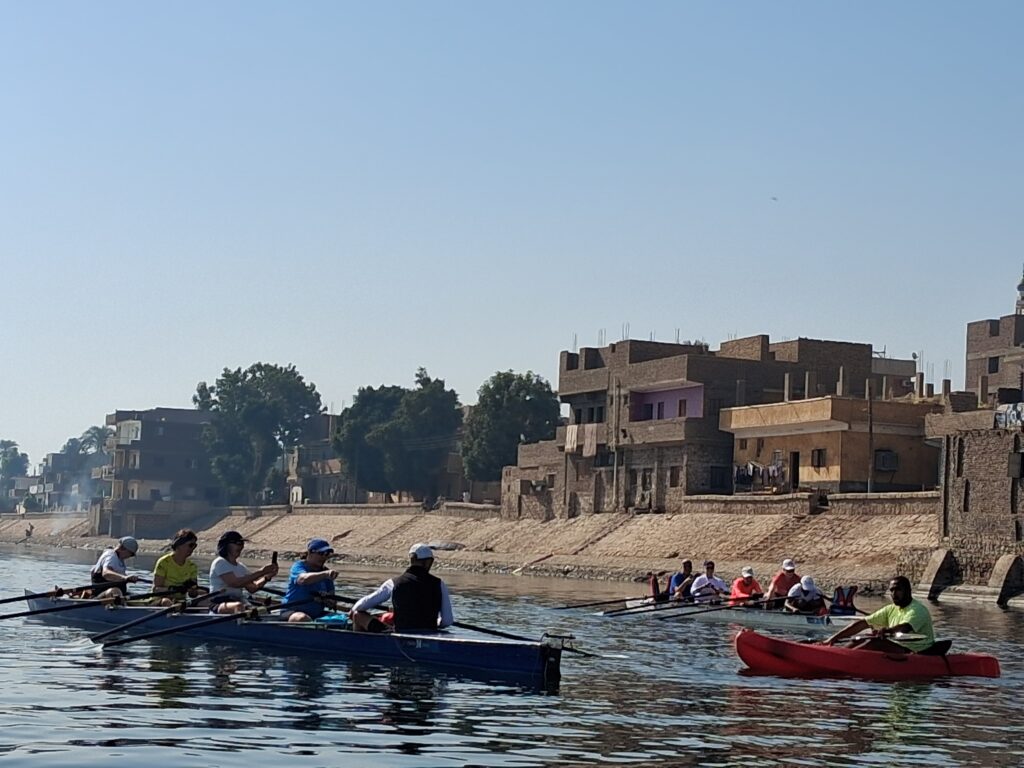
Immediately we fall into the rhythm of the dababeya. Breakfast at 7 am. Watch the crew prepare the rowing shells. Launch, row downriver, the Nubian Kingdom trailing us. At some point in the morning Razis would be towed past us, on the far side of the river. The coxswains would spot her moored on a green bank, the crew ready to help us land. Lunch at 1 pm, with rest, relaxation or quiet conversation before and after. Mid-afternoon launch, row, watch Razis pass us, land, return to the dababeya. Schmutzbier, shower, relax, dinner at 7 pm. The crew engages us with joyful evening entertainment. Most of us were asleep before 10 pm. Repeat. It was spectacular, this easy pattern of pleasure, coddled enjoyment of things we love.
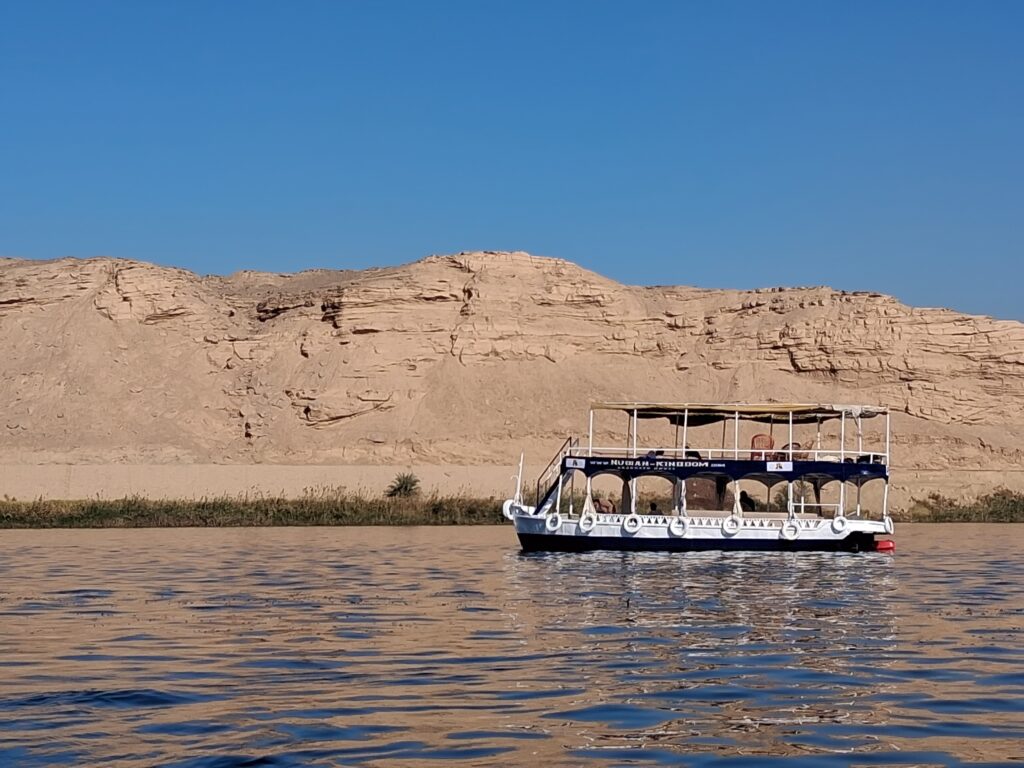
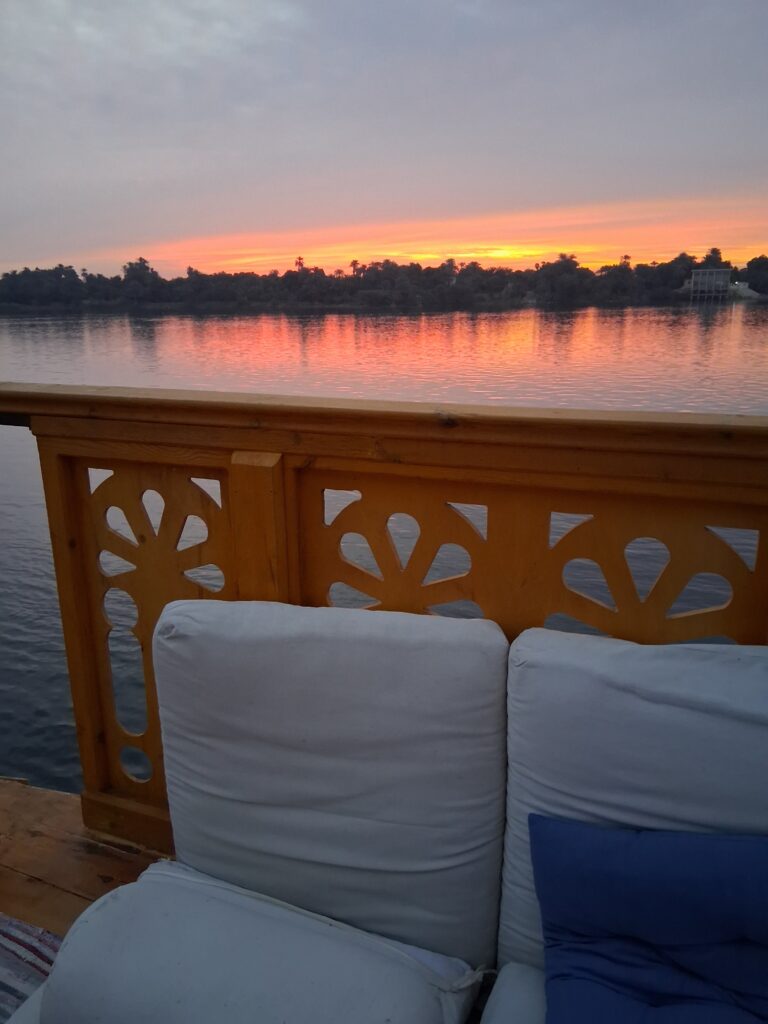
There were other rhythms to our Nile trip. Some of us were up to watch the sun come up, all of us saluted the sun as it set. Many days we heard the calls to prayer even when we could not see any mosques. Our moorings were always delightfully green and felt secluded. There was a regular response when a coxswain waved to people on the shore. “Welcome, welcome!” with a wave in return. And of course there was the slow and regular rhythm of the rowing, the steady push, push, push of the oars.
Crews were announced each evening. Each boat captain assigned seats. Halfway through each morning and afternoon row, cox and stroke switched seats on the water. Sightseeing days at the beginning and end of the tour sandwiched four days down the Nile. Our daily distances were 24, 48, 32 and 20 km. These were shorter distances than originally planned. With the heat – usually over 30 degrees Celsius – and the very hard wooden seats, it was enough. At least for me.
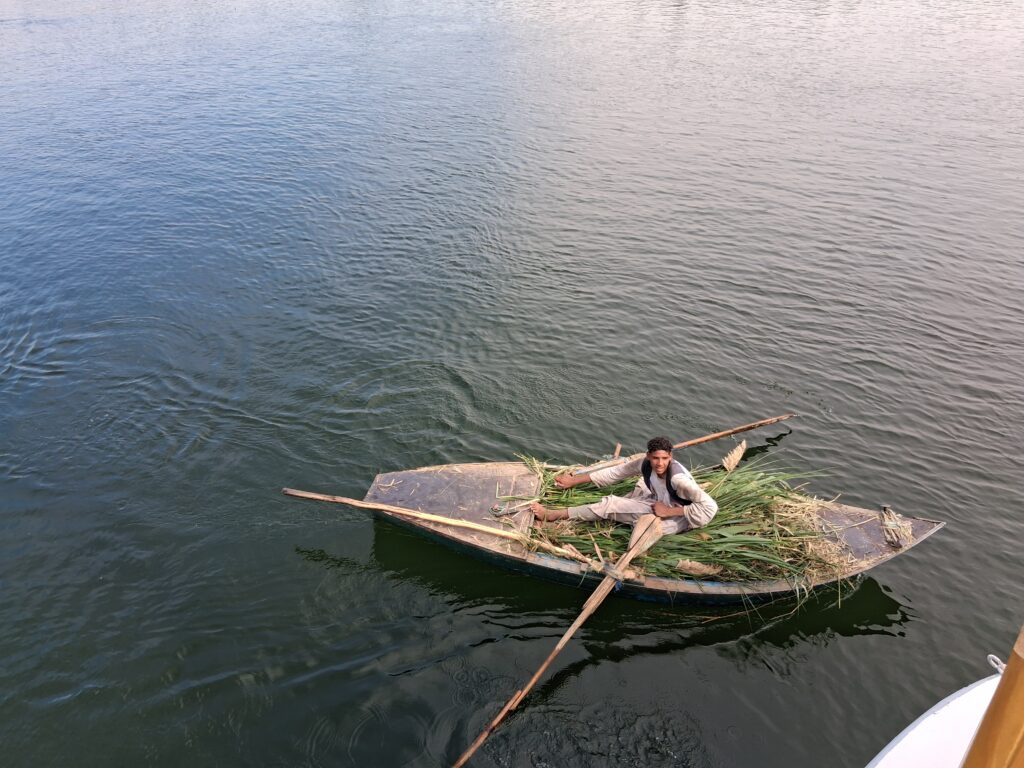
One of the Austrian rowers made an astute observation. Our Egyptian friends were masters of the Plan B, able to adapt and improvise on the fly, always calmly and seemingly effortlessly. She felt that Europeans would not have done quite so well when plans did not go as intended. There would have been fewer smiles. I asked a crew member about how the mooring stops were selected once it was clear that we would not be going as far as planned. The captains of Raziz, Nubian Kingdom and our towing boat had spent their lives on this reach of the river. They knew. I shared that I was impressed with how comfortable the crew were with the rowing shells. Handling them with ease, in one case running the length of a boat floating on the river without oars to stabilize, in another case, paddling an empty quad to the shore using a life jacket. The answer was that the men had grown up rowing. Not our kind of boats, but every day we saw dozens of rowboats. People fished from them or carried plants and sometimes people. They were fixed seat, the rower often sitting straight legged on the cargo. The oars were uneven chunks of wood, short and narrow. These heavy clunky boats were rowed with speed and dexterity, often against the current. They were impressive rowers.
The scenery flowed by over the hours of rowing and coxing. It changed constantly but within a limited set of variations. It was always green right to the shore, except in towns and villages where concrete embankments reached from the water to roads and lines of three-story hours. The green was everchanging. Sometimes tall strands of grass, sometimes palms, sometimes sugar cane, sometimes a mixture of trees and palms and grass and fields of low green crops, sometimes just a thin line of shrubs. Often it was flat. Water, green, sky. Suddenly hills might appear in the near or far distance. They varied in shades of brown through almost black, sometimes looking rounded and worn by the wind, sometimes resembling a crusty topping on a crumble. Once we rowed past a temple complex, columns and doorways marking mysterious entries into the earth.
The seasons of flooding, planting, harvesting might be gone but we found our own rhythm of the Nile. A wonderful rowing and travel experience. Thank you very much to Andrea, Emma, Ali, Ahmed, the support crew and the lovely participants!
(And in case you were wondering from my earlier post, no there were no crocodiles where we were rowing.)
Cairow is keen to organise similar trips in the future. If you have a group of 20 rowers, that is perfect. Travel2Row and Rowing The World is collecting contact information of interested individuals which we will share with Emma. Please fill in this form. You may also contact Emma directly at emma.cairow.watersports@gmail.com .
Hello Ruth , I came across your email about rowing the Nile , this looks spectacular!
I am in fact Egyptian living in switzerland where I also row , I would love to join if this trip is happening again , and I’m sure many of my towing friends would love to do the same
Trip .
Thanks
Fatma
Hi Fatma,
So glad that you found it and enjoyed it. Please add your name to the form that has a link in the post. And your friends can do so too, if they wish. That is the best way to get future information. Enjoy rowing in Switzerland in the meantime!
Ruth