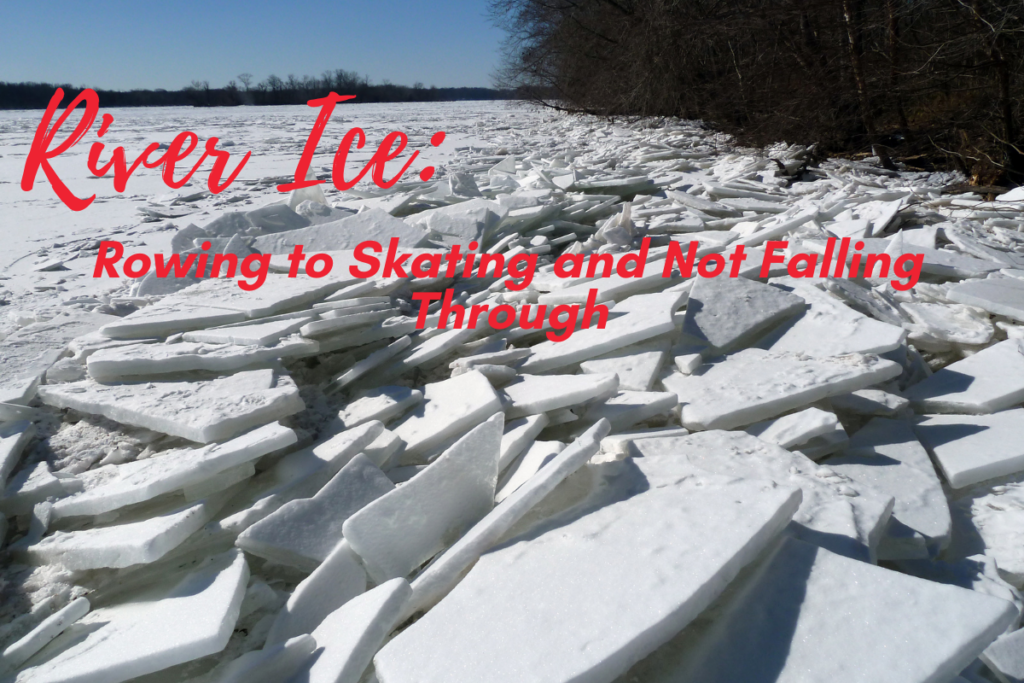
River Ice
I had every intention of walking to the Maryland Bridge and checking the status of the Assiniboine River on a daily basis. I was going to write eloquently in my notebook, lyrically describing the transformation of a river, from rowable to skatable. The freezing of rivers announces the arrival of winter in Winnipeg, It happens every year after the rowing shells have been put away and the docks pulled out of the water, around the time we get a little lost in the flurry of December activities and the shortening of the days. River ice formation is a quiet activity of nature that continues regardless of whether anyone notices, notebook on bridge, or not.
I wanted to watch and document the process this year, acknowledge the transition from a river where we row to a river where we walk, skate and ski. I have a personal interest in the formation of strong ice. We can only observe the very start of the process. Once ice covers the surface completely from bank to bank, its thickening continues unseen, building downwards. Officials bore test holes as the winter progresses to determine the thickness and when it is safe to support trucks, structures and lots of humans. In Winnipeg in the winter, especially at the confluence of the Red and Assiniboine Rivers, the frozen rivers are where people come to be active outside and celebrate that we do winter very well here.
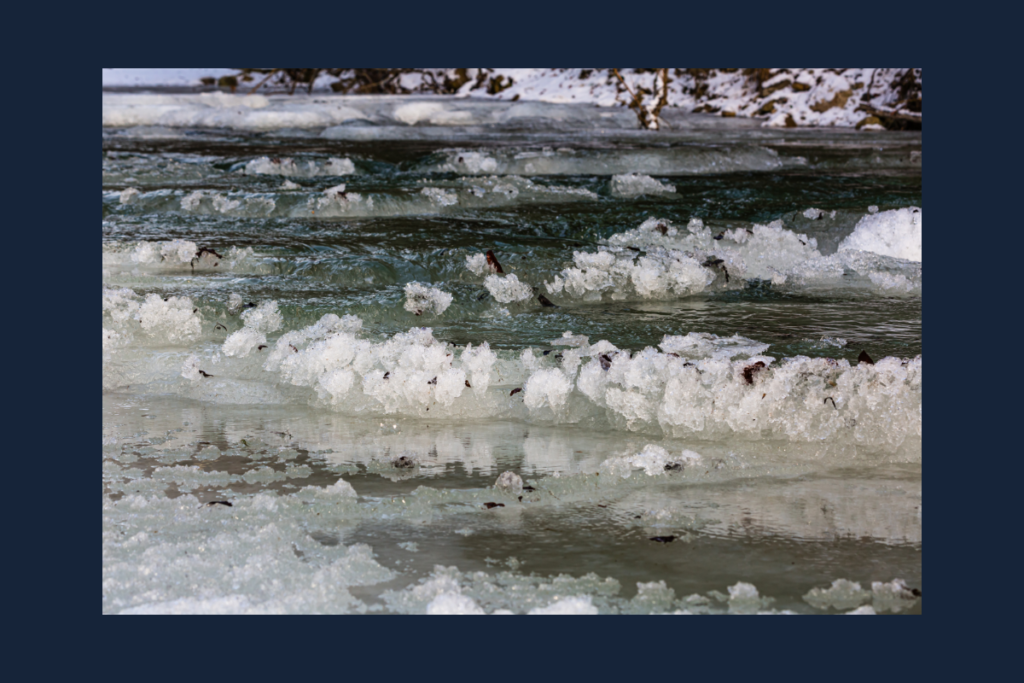
I did not manage the daily observations. One morning in November I walked across the bridge and saw the first river ice and decided to track its progress. A few days earlier, thin whiteish lines of ice appeared intermittently along the shore at the water line but there was nothing in the water. Now, round, jumbled flows of crystals, stained brown with the water’s sediment swirled in the current. There were lots of these pans, crashing into each other, building bigger with every twist and turn. It was a sudden dramatic appearance. It felt exciting and significant. I wanted to chart their consolidation into a single solid sheet of solid ice stretching from bank to bank. Ice that would be safe.
The next day the rubble river ice looked the same, still charging downstream in urgent swirls. The air temperature warmed for a few days along with full sun. Whoosh, the ice was gone, a few fragments clinging to the shore. Then I forgot to check daily, even as the air temperature dropped below zero. A week or so later friends who live along the Assiniboine announced that the river was covered. I had missed the moment.
The Red River is wider and deeper. When I walked the next day along its winding western bank, it was largely covered in a smooth layer of white. Only at the bends was there open water, a few flows and chunks of translucent ice bobbing gently in the slowly moving current. I walked back to the Assiniboine. It was choaked with frazil ice.
I love the word frazil. Frazil ice forms in fast moving current of super-cooled water. It is dramatic looking ice, spikes and jagged chunks locked in a frozen moment when movement stops. The National Research Council of Canada has invested in a frazil ice research centre in Newfoundland and Labrador. Frazil can block municipal water intakes and make a mess of power generation in hydroelectric plants. Significant flooding has occurred in Manitoba when frazil forms massive jams, backing up spring meltwaters. Another funny word: Amphibex. These are large, diesel-powered dredge-excavators which crunch through thick ice to break up potential spring ice jams.
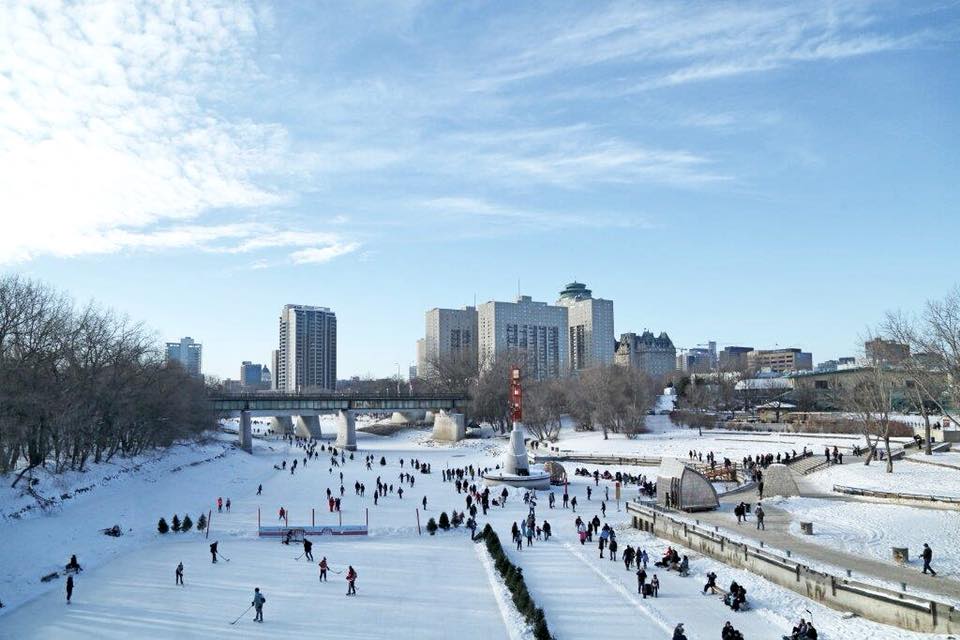
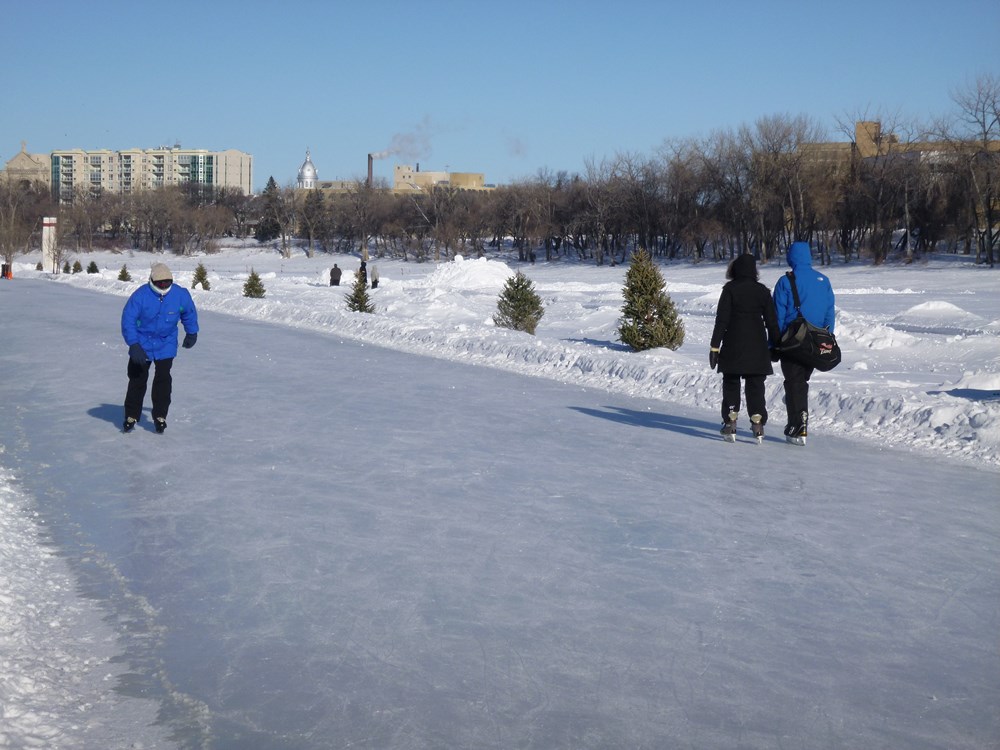
The frazil ice on the Assiniboine does not bode well for smooth skating on that portion of the river this winter. Every year the Nestaweya River Trail is laid on the ice of the Red and Assiniboine Rivers. A skating trail is cleared and then maintained by a team of Zambonis – another wonderful word. If you watch ice hockey, Zambonis are the machines that come on between periods to clean and smooth the ice. Cross-country ski tracks are set and a walking and snow bike paths packed beside the long skating trail. If there is not much frazil ice on the Assiniboine, the trails can stretch as far as 11 km one way, partway up the Red, partway up the Assiniboine. An international art and architecture warming hut competition brings wild and wacky structures for skaters to glide by or stop to explore, many of them offering beauty but no shelter from the wind. It all makes for wonderful winter fun supported by strong ice.
Falling through the ice is a terrifying experience. A huge snowstorm had blanketed the city in 40 or more cm of snow. The next morning, a Sunday, was bright, clear and very cold. It was like the neighbourhood was stunned into silence. There were no cars – the roads had not been ploughed and were essentially impassable. It would take a few days for the clean-up and longer before the cross-country ski trails were packed, groomed and ready for what would be magnificent skiing. I decided to go snowshoeing on the river. It was beautiful. The fir trees wrapped in white blankets, not a sound, not a trace of movement. No footprints, no animal tracks. There was no one anywhere. The river with its unblemished cover was all mine.
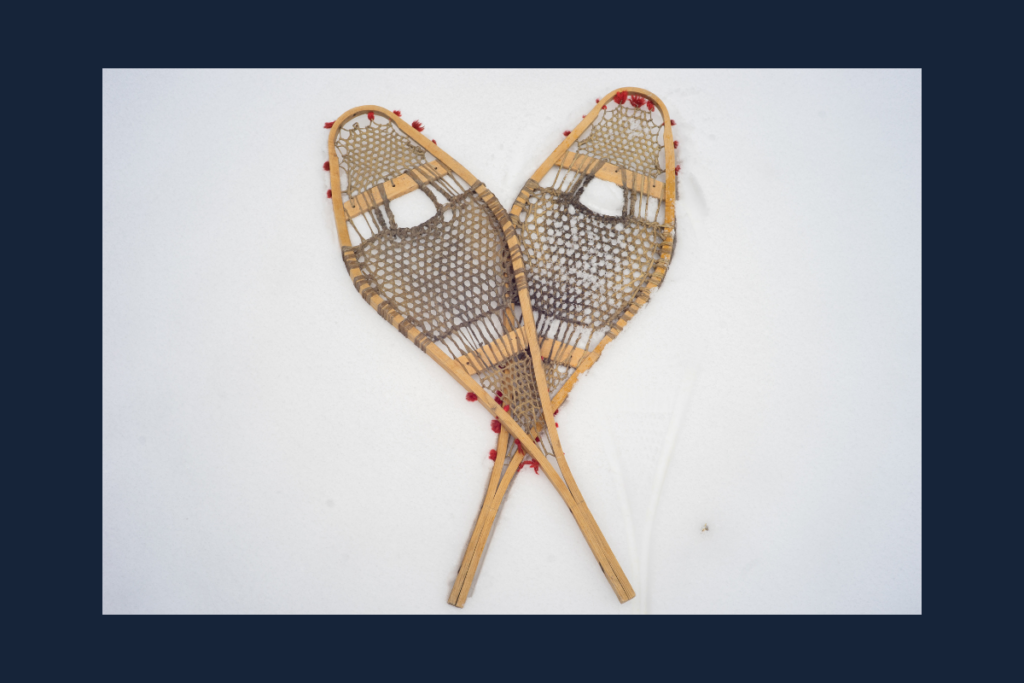
My snowshoes are beautiful, the old beavertail or Huron style of curved wood and rawhide, wide by the hole where you strap your foot and tapering to an elegant tail. I had tall sheepskin moccasins designed for snowshoeing. The straps were leather with two metal buckles each. One tightened over the top of your foot by the hole, allowing your foot to flex in and out. The second buckle attached a long strap around the back of your foot, ensuring that you did not slip out of the harness. The width of the snowshoes forced you to step fully forward, tucking the back curve of forward foot into the front curve of the back foot. Chewh, chewh, chewh. One foot into the deep snow ahead, sink a little, next foot forward, the toe box of your moccasins dipping briefly into the hole as the tails left uninterrupted, graceful lines over the webbed print of the rawhide.
I pointed my snowshoes upstream and began stepping steadily forward. It was magnificent. I could not have been happier. I was well bundled against the cold – down parka, long underwear with fleece lined over pants, sheepskin hat and mitts. The Assiniboine flows essentially west to east, A brisk north wind dropped the wind chill into an unpleasant zone. I decided to cross to the north side of the river as I continued west towards the Maryland Bridge, hoping to get into the lea of the riverbank.
Suddenly my right leg went through the snow and ice and was in the water. I tipped forward and my arm was submerged. I could feel the edge holding my left side crumbling. The urge to keep going north where the bank was so close was strong. Now I remembered seeing a patch of open water days before when crossing the bridge. It would be worse that way.
Somehow I rolled myself out of the water to the left and crawled back toward the middle of the river. The ice held. Now I was desperate, pulling off my mitts to work at the harness with instantly cold-burned fingers to get my feet out of the straps before the buckles froze solid in the -30 degree temperature. I did it. Shaking with adrenaline and cold, I staggered back through my tracks to the riverbank, up to the street and somehow home.
Clothing made from the warmth of animals saved me – down and sheepskin. My soaked mitt froze so solid that it cracked in half when I worked it off to somehow get my key out and open my front door. The one moccasin also suffered damage but my down parka survived and so did I, with no frostbite and no hypothermia.
I still walk and ski on the river in the winter, but I only go where others have gone before me, when I can see that the ice has held them and will also hold me. I remain interested in how ice forms and builds. I look carefully from bridges to see if there is a hint of open water or a patch that just does not seem right. Ice is a beautiful thing and I respect it very much. I also look forward to when I can row again.
Oh how my soul was stirred by memories of Winnipeg….winter running in the snow, ice and cold ( as low as minus 35c) alongside others in our three light, but warm layers and our face masks making us look like icy masked bank robbers. Nothing so exhilarating as a long Sunday morning run followed by hot chocolate and companionship.
Hi Margaret – lovely to hear from you and what a great description of memories of Winnipeg! Yes, winters can be very wonderful and special here.
[…] rivers are ice so I can’t do any on-water training at home. I am not a fan of the ergometer and will do anything […]