Auf Wiedersehen Berlin & the World Rowing Tour
I owe a debt of gratitude to the World Rowing Tour. And so I was both honoured and saddened to attend the final World Rowing Tour which took place in Berlin in May 2025. The majority of rowers around the world were never or barely aware of these 61 events which began in 1972, fittingly in Berlin. It is worth taking a moment to celebrate what World Rowing Tours accomplished and how tour rowing can continue to contribute to the growth of our sport.
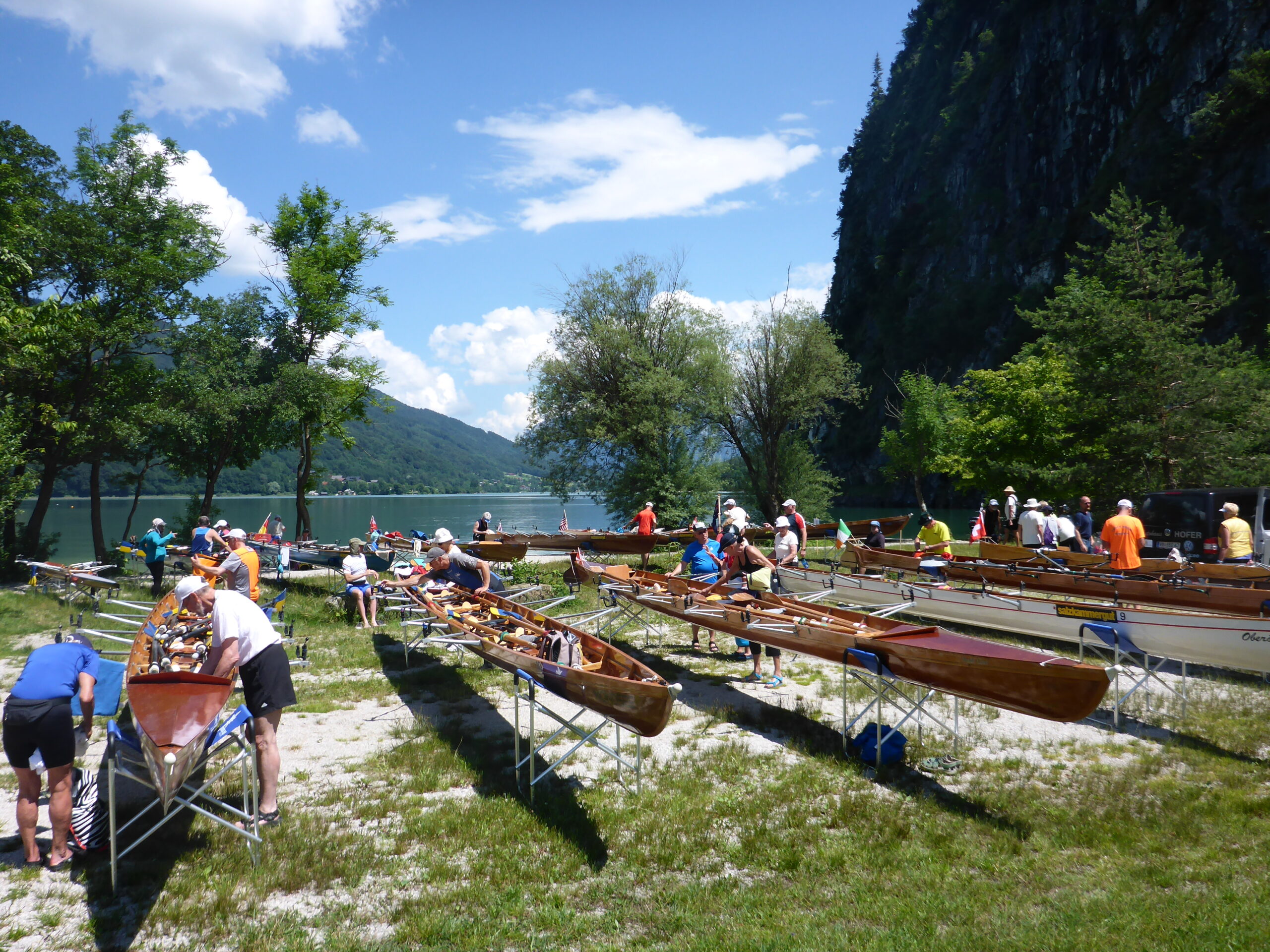
A typical World Rowing Tour lasted a week with up to 100, but usually 60 rowers from perhaps a dozen different countries. Usually rowing coxed quads for roughly 20 to 30 km a day, the tours followed scenic routes in countries around the world. Many took place in Europe with some countries such as Germany and Italy hosting more than one, but World Rowing Tours were held in North America, South America, Asia and in Australia and New Zealand. Planning usually took several years and required sanctioning by the national rowing federation and support from regional organizations and local clubs. Dignitaries gave welcome speeches, rowing officials offered congratulations and praise at the end. There were ceremonies with the flags of the participating countries, receptions in the evenings. Most importantly there was rowing and comradery, strong friendships forged while rigging or derigging the boats, working together to lift boats in and out of the water, a constant rotation and change up of boat crews. Usually by the end of the tour you had either rowed with or eaten with or both with every other person involved.
When underway, the tours were moving masses of people, buses, boats, oars, trailers and the logistical support to feed and house athletes hungry and tired during and at the end of long days, maybe burnt by too much sun or cold and drenched from never-ending rain. Launching and landing up to 16 boats sometimes in limited space necessitated periods of waiting followed by frenetic activity and then more waiting. Then it all settled into the rhythm of the rowing, stroke after stroke, sure and steady, maybe the occasional impromptu race with another boat for 20 strokes or until one clearly took the lead, then everyone dropped back to a tour pace that could be sustained for hours, with breaks for water, snacks, photos and maybe some splashing and joking about.
Some tours ran perfectly, others encountered glitches and challenges. There were always stories from the tours, sometimes of overcoming threatening water and weather conditions, perhaps of frustration when the boat did not run well or when a serious snafu in logistics spoiled the day, sometimes of hilarious gaffs or memorable pranks or maybe of poignant, personal moments when the light on flat water turned the world around your boat golden or maybe when assistance was silently provided with a smile.
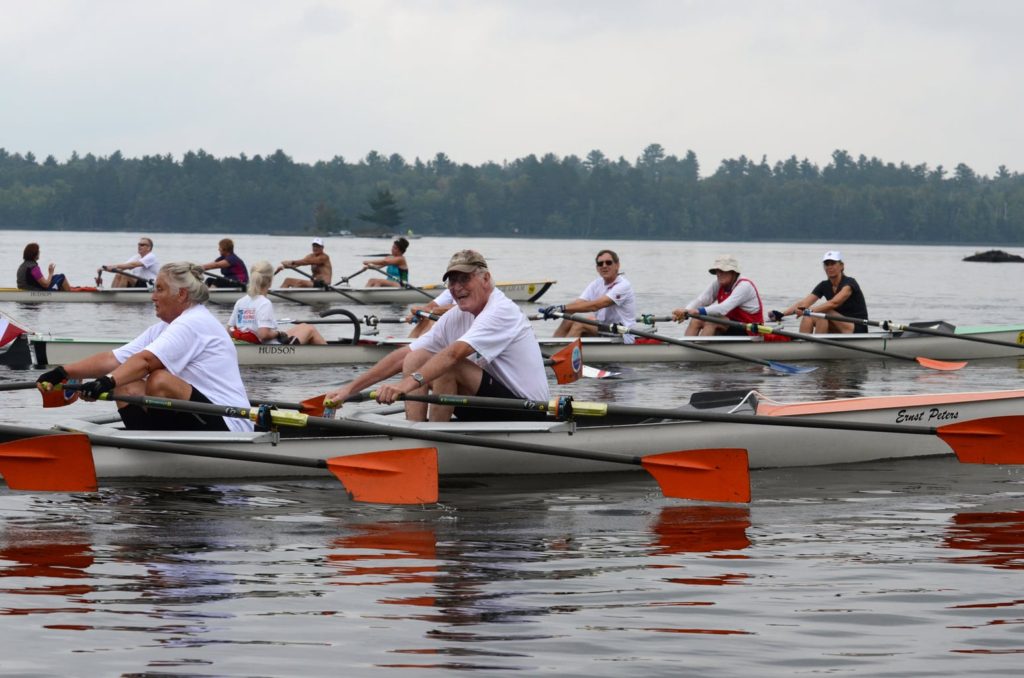
World Rowing Tours contributed to the creation of my business, Rowing The World, and helped support it in various ways. In 2012 I was researching starting a rowing travel business. I had owned and operated a cycling and walking tour company for 15 years, and after a break of a few years wanted to return to adventure travel in a different way. I loved to row and thought that there might be a niche business opportunity. I remember working in a hotel room in Vancouver in May, researching potential competitors and the potential market. I discovered this thing called a World Rowing Tour which was going to be held in August in northern Ontario. How perfect! I emailed the main organizer who kindly replied that there was an application process which had been completed much earlier in the year and that the tour was full. Just a few weeks before the start I got an urgent email from Donna, asking if I were still interested and available. There had been a cancellation and the seat was mine if I wanted it.
It was my first exposure to distance rowing and especially to the universality of the sport. Five people from five different countries who have never met before can get into a boat and all immediately work together to make that boat move. Fourteen years later I am always thrilled and astonished when it happens on my own or others tours.
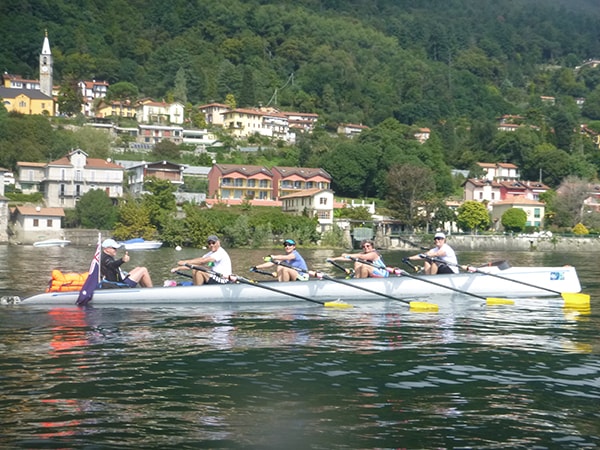
From that first FISA World Rowing Tour and subsequent ones I developed a group of loyal clients and word of mouth that led to more guests. I’ve run rowing trips in 20 different countries and three of those tours had their origin with a World Rowing Tour enhanced by long term collaboration and friendship with the original organizers. I partnered with World Rowing to develop the first ever Development Rowing Tour in the Maldives, where funds were raised to support the growth of our sport in a country where it had only recently been introduced. I discovered coastal rowing through the tours, which has become my favourite form of rowing and opened up remarkable opportunities to row in places like Greece, Turkey, Japan, Panama, Martinique and the wilderness of Canada, where even the more stable touring boats would not be usable. World Rowing Tours have fulfilled me personally and professionally.
The reasons for the demise of the World Rowing Tour are complex. They are difficult events to design and operate. The necessary conditions are hard to find: a group of dedicated and knowledgeable volunteers; a large enough pool of boats which often need to be collected from many locations; a long enough waterway that offers scenic beauty and variety with enough places to store boats overnight at about the right distance along the route and sufficient launching and landing spots to stop for breaks and lunch; adequate safety and support measures and provision to cope with any number of challenges. Insurance became difficult to obtain and very expensive. National federations, as well as World Rowing, are increasingly stretched thin with smaller budgets, fewer staff and many competing priorities. It became harder to get attention and support for tour rowing.
The 2025 World Rowing Tour in Berlin was hugely successful. Berlin offers a remarkable system of waterways lined with over 60 rowing clubs. The tour began in the eastern part of the city and traversed rivers, lakes, canals and locks to end to the south and west in Potsdam. There were many highlights including dinner at the national training centre, rowing the course from the 1936 Olympics made famous by Boys in the Boat and passing through the heart of the city with its iconic buildings – which required special permissions and an escort by the water police. Most of the participants had enjoyed previous World Rowing Tours. There was dismay that the tradition was ending but also recognition of what had been achieved in about 50 years of the tours.
The past decade or so has seen an expansion of rowing. Perhaps more accurately there has been an embracing of what is accepted as rowing beyond skinny boats racing down a straight 1,000 or 2,000 metre course. Classic rowing remains the core of our sport or course, but rowing is much more complex, which makes it more interesting. Indoor rowing and coastal rowing have grown and been recognized as important variations in our sport. Tour rowing, para rowing and fixed seat rowing are more variations which many rowers may not “see” if it does not occur near their boathouse. For example, there are about 90 Cornish Pilot Gig rowing clubs in the United Kingdom with over 8,000 active rowers. That is just one kind of fixed seat rowing. For comparison, in 2024 in all of Canada there were 128 rowing clubs and 12,293 registered rowers. The number of people enjoying rowing travel or tour rowing is much smaller, perhaps because it has not been very visible to North American rowers. The concept is well understood in Europe, where many clubs and national federations organize their own tours locally and internationally and there has been a growth in the number of commercial companies.
“World Rowing Tours have always been a showcase for representing our sport”, said Andrea Ranner of Austria, who has represented tour rowing on World Rowing commissions and her national federation and was instrumental in the organization of the tour in Berlin. “The event brought together rowing enthusiasts from around the world. With tour rowing participants can explore scenic coastlines, lakes or rivers and build lasting friendships. The tour is a non-competitive format and designed for rowers of all skill levels, promoting the sport of rowing, cultural exchange, and the joy of exploring new places by water.”